
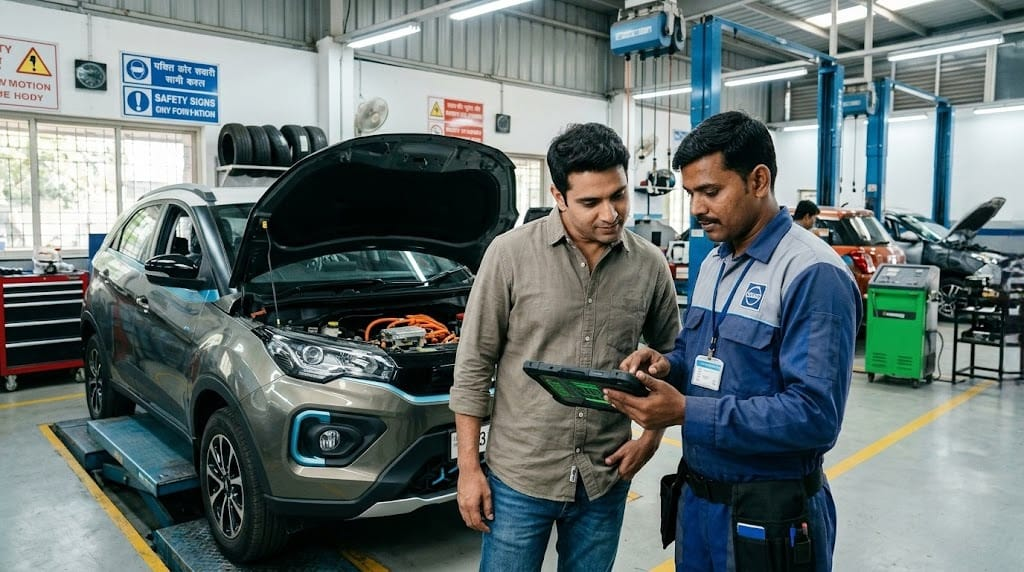
At an Indian EV showroom, the conversation usually starts with range, screens, and fuel savings. I would add one less glamorous question before signing: “If the battery develops a fault after the warranty, who diagnoses it, where is it repaired, and what exactly will I pay for?”
An EV battery rarely fails like a light bulb. Capacity normally declines over time, while a sudden fault may involve a module, sensor, contactor, cooling circuit, or control software. The remedy-and the bill-depends on the exact model, the failed part, the warranty, and the manufacturer’s repair policy.
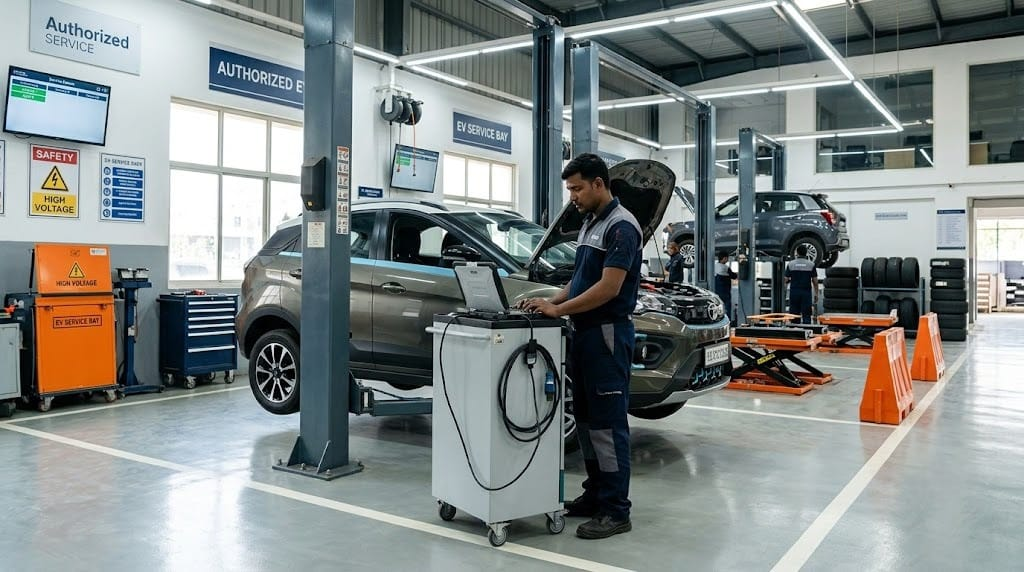
That is why a dramatic online price is not a diagnosis. A complete pack replacement can be expensive, but it is not the automatic result of an ageing battery. Ask an authorised service centre for a written diagnosis and quote, tied to the vehicle identification number, then compare it with the warranty wording.
The battery is among an EV’s costliest components, so the concern is legitimate. The problem is that online estimates often combine different models, pack sizes, labour charges, taxes, and parts availability. The main question remains that what does an EV battery cost and it’s likely repair path for this car.
What Does an EV Battery Replacement Cost in India?
No single, reliable India-wide replacement price exists. Battery capacity, chemistry, pack architecture, software, labour, taxes, and parts supply all affect the total. A small city car and a large electric SUV cannot sensibly share one headline figure. Treat published numbers as dated context, not as a quotation.
Before trusting any price table, check its publication date, vehicle variant, battery size, currency, tax treatment, and whether it includes labour. The table should also identify its source-ideally a manufacturer price list, an authorised-service quotation, or a clearly attributed industry report.
If those details are missing, label the figures as unverified estimates rather than presenting them as current replacement costs. When comparing cars, request three things in writing: the battery warranty duration and mileage limit, the minimum capacity or State of Health covered, and the manufacturer’s policy on module repair versus full-pack replacement.
That paperwork is more valuable than a confident showroom promise. Here is what an out-of-pocket full pack swap looks like across the most popular EVs on Indian roads, along with the safety net you get from the factory:
| EV Model | Battery Size | Est. Full Pack Cost | Standard Warranty | Lifetime Cover (1st Owner) |
| MG Comet EV | 17.3 kWh | ₹2.5 – ₹3.5 Lakh | 8 Yrs / 1.2 Lakh km | No (Standard/limited term warranty) |
| Tata Tiago EV | 19.2 / 24 kWh | ₹3.6 – ₹4.8 Lakh | 8 Yrs / 1.6 Lakh km | No (Standard 8 yr / 1.6 lakh km terms apply) |
| Tata Punch EV | 25 / 35 kWh | ₹4.5 – ₹7.5 Lakh | 8 Yrs / 1.6 Lakh km | No (Standard/extended coverage limits) |
| MG Windsor EV | 38 kWh | ₹5.5 – ₹7.0 Lakh | 8 Yrs / 1.6 Lakh km | Yes (For 1st private registered owner) |
| Tata Nexon EV (45) | 45 kWh | ₹7.0 – ₹9.5 Lakh | 8 Yrs / 1.6 Lakh km | Yes (Lifetime / unlimited km for 1st owner) |
| Tata Curvv EV | 45 / 55 kWh | ₹7.0 – ₹10.5 Lakh | 8 Yrs / 1.6 Lakh km | Yes (Lifetime / unlimited km for 1st owner) |
| Hyundai Creta EV | 51.4 kWh | ₹8.0 – ₹11.0 Lakh | 8 Yrs / 1.6 Lakh km | No (Standard 3 years / unlimited km vehicle warranty; battery covered under standard manufacturer terms) |
| Mahindra BE 6 / XEV 9e | 59 / 79 kWh | ₹9.5 – ₹16.0 Lakh | 10 Yrs / 2.0 Lakh km | Yes (Lifetime / unlimited km for 1st private owner) |
| Hyundai Ioniq 5 | 72.6 kWh | ₹11.0 – ₹14.0 Lakh | 8 Yrs / 1.6 Lakh km | No (Standard 3 years / unlimited km general warranty) |
Why a Battery Repair May Cost Less Than a Full Replacement
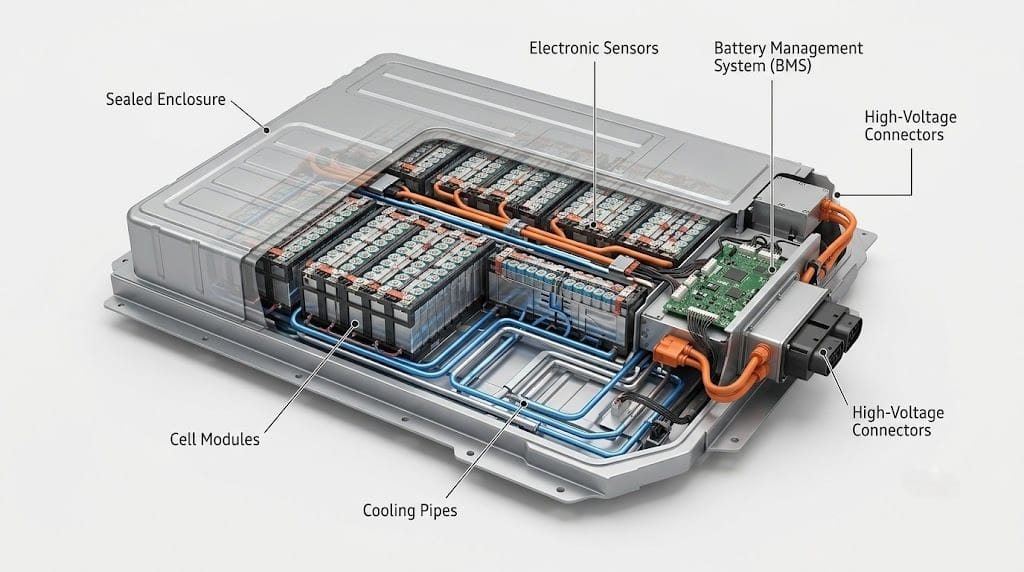
A traction battery contains cells and modules inside a sealed enclosure. A diagnostic scan may point to a weak module, cooling fault, sensor, contactor, or software issue. Only a qualified technician can decide whether the answer is a repair, module replacement, or full-pack replacement. A warning light alone does not prove that the entire battery is unusable.
Which EV Buying Strategy Makes Sense?
For a long-term owner, warranty clarity and the local repair network deserve at least as much attention as brochure range.
- The warranty-first buyer: Read the exclusions, mileage limits, service requirements, ownership rules and transfer terms.
- The battery-rental buyer: Add the per-kilometre or monthly battery charge to your expected driving cost. A lower purchase price is not automatically a lower ownership cost.
- The city-car buyer: A smaller pack may reduce the worst-case replacement bill, but chemistry alone does not decide durability. Heat, charging habits, underbody damage and after-sales support matter too.
How Owners Can Protect Battery Coverage
Warranty terms govern any rejection; an accessory or late service does not automatically void coverage. Still, disputes are easier to resolve when owners avoid unauthorised high-voltage work, keep scheduled maintenance records and document water or impact damage. Save invoices, diagnostic reports and photographs in one place.
- Avoid unapproved wiring modifications: Ask the manufacturer about an accessory before it touches factory wiring or charging equipment.
- Follow the service plan: EVs’ routine maintenance is quite less compared to petrol and diesel cars, but it is not zero maintenance.
- Use suitable charging equipment: Use a properly installed charger and follow the carmaker’s guidance. A roadside charger and a household socket are not interchangeable simply because both deliver electricity.
- Take water and impact damage seriously: Even if the ingress rating describes something, please note that the rating is mostly based on a controlled test environment. Avoid taking the cars to submerged areas for extended battery life.
Checks Before You Sign
- Read the transfer terms: Confirm whether the battery warranty follows the vehicle or the original buyer, and keep the answer with the purchase documents.
- Check chemistry and thermal protection: LFP and NMC have different trade-offs. Ask about thermal management, charging limits, and recommended storage instead of assuming one chemistry is always best.
- Review insurance exclusions: Check battery, charger, flood, and underbody coverage, along with exclusions and the deductible. Product names are not a substitute for the policy wording.
- Request a battery-health record: Ask what State of Health or diagnostic report the service centre can provide. A dated record helps with future troubleshooting and resale.